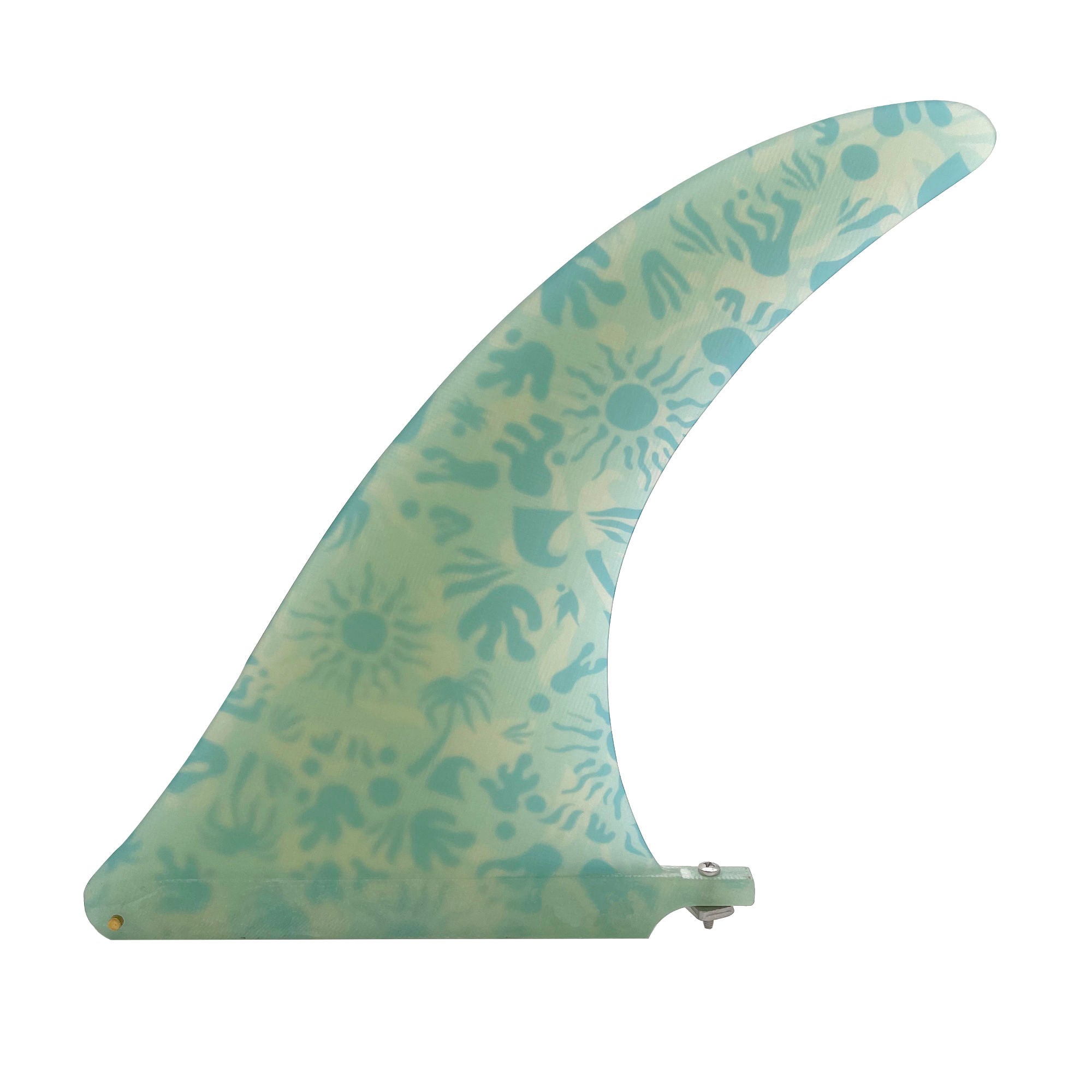
You've just bought a beautiful longboard (or you're about to buy one...) and you want to equip it with a fin, but you're not sure which one? You've come to the right place; we'll help you see things more clearly!

First thing: we're mainly talking about a single fin here.
NB: If your longboard is a performance longboard and is equipped with 3 plugs (2+1 configuration), the choice is easier as you need 2 side fins and 1 center fin. The center fin is generally between 6.5 and 7.5 inches with a fairly classic shape (example: https://www.woodstockshop.com/products/surf-system-classic-fiberglass-single-fin-us-box-blue).

For a "single" longboard (a single fin), the choice of fins is wider and will depend on:
- The type of board you have chosen
- The type of riding you want to practice (noseriding with stability, or increased maneuverability, or glide and speed, for example)
- Your size/weight
- The size of the board

Noserider Longboard: Which fins? (photo above: Almond™ Noserider)
A longboard specifically designed for "noseriding", with a fairly wide, very rounded nose, a generally wide square tail, a pronounced spoon (concave at the front), and a good deal of volume, will typically require stability and (depending on your skill level) a rather imposing fin between 9 and 10, or even 10.25 inches. This type of board works well with either a very wide, almost square "pivot" fin, with a wide base, little rake (vertical profile), and a lot of surface area to act as a very stable anchor point, allowing you to walk on the board without it reacting too quickly. The goal is maximum stability for docile behavior and maximum inertia of the board. This stability will come at the expense of maneuverability, as a pivot fin turns less easily and more slowly than a classic single fin that is more tapered and sharpened, with more rake and less surface area.
Noserider example: https://www.woodstockshop.com/products/almond-walks-on-water-90-pu-clear
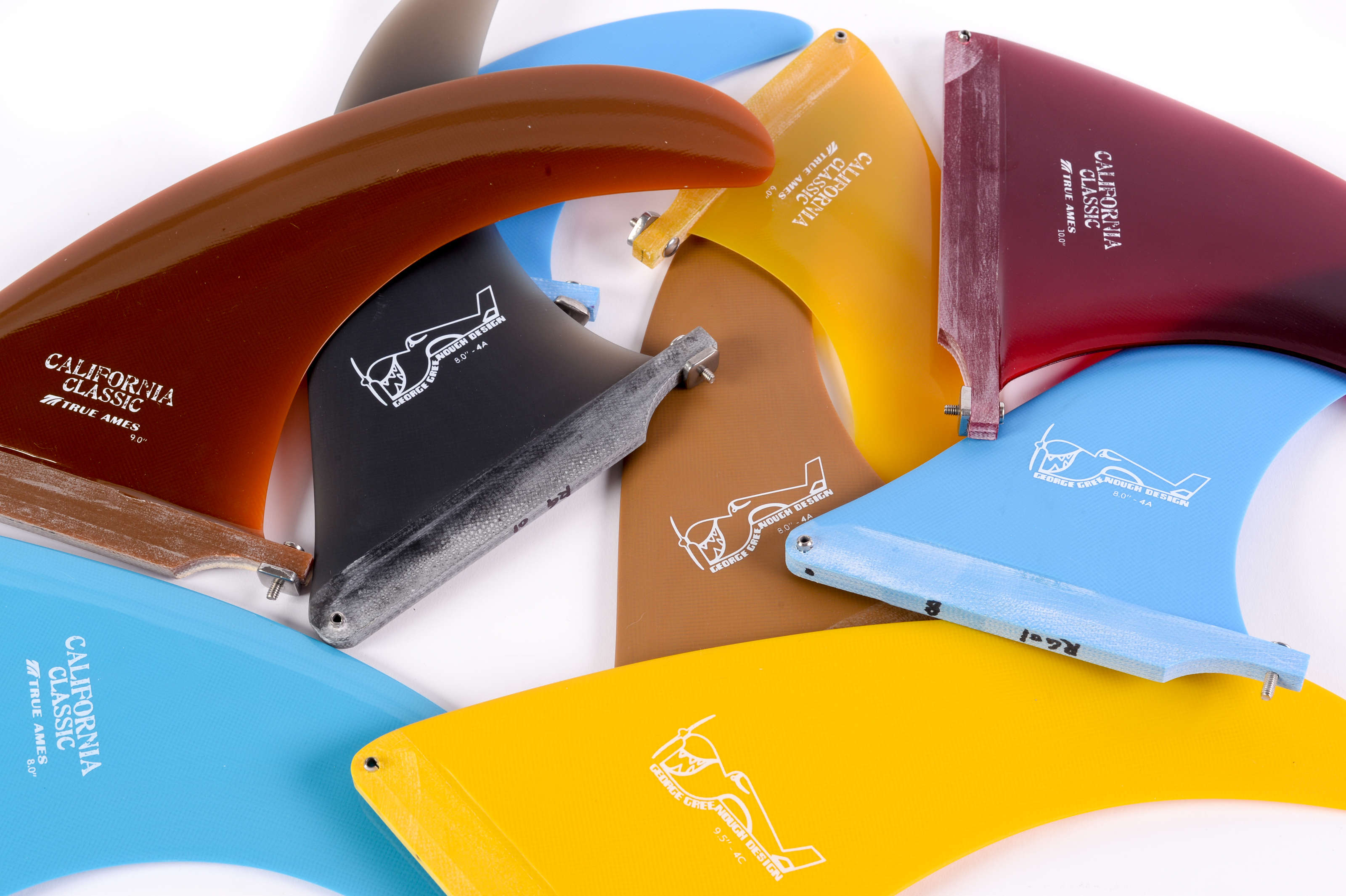
If you're looking for a compromise between stability and maneuverability, opt for a more classic fin (example here: https://www.woodstockshop.com/products/true-ames-california-classic-90-black) which will provide both stability and maneuverability. A kind of "middle ground" between the pivot fin, which can sometimes be too slow to maneuver, and the more performance-oriented, sharpened fin, like the True Ames Greenough A4, for example, which has even more rake (a pronounced curve towards the back of the board) and even less surface area, with a rounded and tapered shape like a dolphin's dorsal fin. Adapt the fin size to the board size (generally, a large board = a large fin and vice-versa) and to your size/weight (generally, a large rider = a large fin and vice-versa).

All-around Longboard: Which fins? (photo above: Aloha™ all-around longboard)
If your longboard is a versatile longboard allowing for some nose riding but also more relaxed surfing, following the wave, pumping for speed, making some turns, and maintaining versatility depending on conditions, then a classic fin (not a pivot fin) will be good. This will adapt better to this type of longboard, which has either a square tail that is not too wide, a rounded square tail, or a pin tail. The classic fin will offer ideal behavior and allow your versatile longboard to deliver its best. Adapt the fin size to the board size (generally, a large board = a large fin and vice-versa) and to your size/weight (generally, a large rider = a large fin and vice-versa).
Example of a classic fin: https://www.woodstockshop.com/products/surf-system-classic-fiberglass-single-fin-us-box-red?variant=40918859808804
Example of an all-around longboard: https://www.woodstockshop.com/products/aloha-surfboards-pintail-noserider-94-pu-sky-resin-tint

Pig & Modern Pig Longboard: Which fins? (photo above: Modern Pig "involvement log" type from Almond™)
If your longboard is more of a "pig" type, with a slightly narrower nose and a low wide point, you have several choices available to you:
- Either it's a very old-school and voluminous pig, with rounded rails, a small square tail, and volume; it will require an imposing fin, either a pivot type or a vintage D-Fin type (very vintage example: https://www.woodstockshop.com/products/true-ames-yater-spoon-975-white)
- Or it's a longboard pig-type but more modern and revised (called "involvement logs" by purists and connoisseurs), with a slightly narrower nose, a small square tail but more pinched rails, a longboard with volume certainly, but moderate, less thick than a classic old-school big pig (example of a modernized pig longboard: https://www.woodstockshop.com/products/almond-longboard-surf-thump-92-pu-clear-9338) - for this type of board, you'll need to choose a fin that's stable but not too much, so you can make the most of your board and make it lively underfoot without it becoming capricious or unstable. Here we recommend either a classic fin (stable and reliable) or a True Ames Greenough A4 type fin (stable but playful and more reactive). The 4A type fin often appeals to riders who want finesse and reactivity; you need to surf well or know your board well with this fin because it is more sensitive and requires a bit of dexterity and finesse to master on a longboard, but it's a real pleasure to surf. (Example: https://www.woodstockshop.com/search?type=product&q=greenough+4A) These fins are often surfed between 9 and 10.5 inches depending on the size of your longboard and your size/weight. Adapt the fin size to the board size (generally, a large board = a large fin and vice-versa) and to your size/weight (generally, a large rider = a large fin and vice-versa).

Glider Longboard: Which fins? (photo above: Almond™ Glider)
If your longboard is a glider with a pintail, designed for speed and glide, and you prioritize glide above all else, you will need a fin that does not prevent the board from turning and does not slow it down, but still offers a minimum of stability at speed. We generally recommend a classic fin or a Greenough A4 type fin depending on your preferences, or a Skip Frye style: emphasis on stability, small to medium waves with a classic fin, or emphasis on maneuverability, reactivity, and slightly larger waves with a Greenough A4 type fin. Adapt the fin size to the board size (generally, a large board = a large fin and vice-versa) and to your size/weight (generally, a large rider = a large fin and vice-versa).

Performance Longboard: Which fins? (photo above: Stewart™ Performance Longboard)
If your longboard is a "performance" or "comp" longboard with a round tail or pintail, there's a 99% chance it's set up as a 2+1 and you'll need to find a center fin and 2 side fins. We do not recommend surfing this type of longboard as a single fin; they are not really designed for it, and you won't be able to get the most out of it perfectly.
Rarer case: the versatile longboard where the shaper has installed side boxes to offer a choice between a 2+1 setup or a single fin setup. In this case, it will be good to use a classic single fin (a 9-inch fin or larger, of course). If you use the board as a 2+1, you will need a classic center fin much shorter than 9 inches (rather 7 inches) and 2 side fins.

Fin Size: Board and Rider Size/Weight
To choose the size of your fin, regardless of the type of fin, you will need to consider 4 main criteria:
- Type of board: A noserider will tend to prefer a large fin, with plenty of surface area for maximum stability. A pig will prefer a fin with a wide base and also a lot of surface area (pivot or very wide old-school fin). A versatile all-around longboard will require a classic or Greenough 4A type fin to remain maneuverable, a reasonably sized fin, neither too small nor too large. An involvement log (more modern pig) will require a classic or Greenough 4A type fin, carefully chosen according to your skill level, your size/weight, and the desired degree of finesse and reactivity. A glider will require a classic or Greenough 4A type fin that is not too large, because at high speeds, a fin that is too large will hinder you.
- Board size: The longer the longboard, the more volume it will have, and the larger fin you will need to control and master the board. It's then up to you to refine based on your personal preferences, your skill level, and the type of board.
- Your size/weight: Generally, a smaller rider = a shorter longboard and a shorter or narrower fin; conversely, a larger rider = a larger board, a larger fin, and more surface area.
- Your skill level: With a good skill level, it often happens that the surfer seeks more finesse in wave feel, turns, and positioning, and therefore chooses a thinner fin or one with less surface area because it will allow for precise and subtle control. Conversely, if you are a beginner, there's no point in taking too small a fin; don't be afraid to take a fairly large fin because it will provide stability and allow you to progress.
Note: whatever your board, your level, or the type of fin: don't hesitate to adjust the fin in its box (forward and backward) to find the ideal placement of the fin by feel. You have to test and discover the ideal placement; there is no absolute rule.
Finally, don't hesitate to try different fins on your board. There's theory, but also and especially practice, and it's by testing that you find your preferred fin or the fin best suited to the board you're surfing. Fins play a huge role in board control and the feel you get. A board can be magical with the right fin or, conversely, frustrating and disappointing if you don't find the right fin.